
We Closed the Third Places. Then We Called It a Crisis
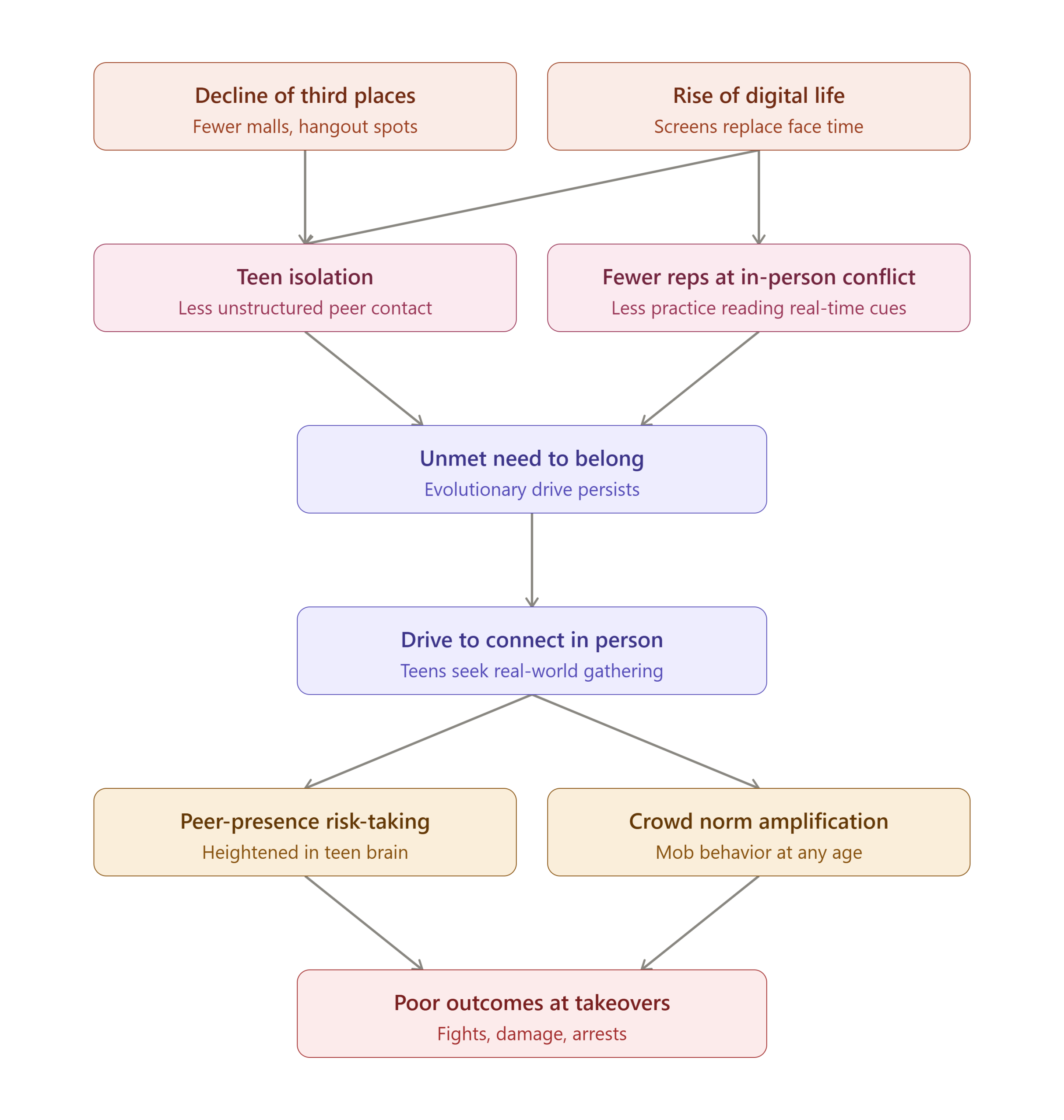
Fig 1: Teen Takeover Logic Model
Imagine you’re 15, and it’s the first day of your sophomore year of high school. It’s been a long, hot, boring summer, and a text lights up one of your friend group chats: there’s a meet-up at a public shopping area right after school. Your first thought isn’t “we’re going to cause so much trouble.” It’s adrenaline and the pull of connection, of being together with other people in real life.
Both research and plain observation show that young people today are increasingly isolated. The “third space” (places young people are welcomed and encouraged to go that are neither school nor home) has been steadily disappearing. Baltimore City operates about half as many public recreation centers in 2026 as it did in 1976, a decline that has outpaced the city’s own population loss. Youth employment hit an 80-year low this summer, as Fortune reported. Meanwhile, fear of young people has driven a wave of age restrictions at malls, movie theaters, and other public gathering spaces– closing off exactly the places that might otherwise absorb this need.
Research suggests humans have an evolutionarily rooted drive to seek connection with one another — and denying that drive isn’t just inconvenient; it’s painful. A large study of adolescents in Japan found that kids without access to a third place were significantly more likely to have low self-esteem, independent of family circumstance, an effect nearly as strong as lacking a mentor or role model entirely (Frontiers in Psychiatry).
Today’s high schoolers were in late elementary and middle school during the pandemic, a critical stretch for social development that many of them spent largely alone. The omnipresence of technology compounds the problem: when so much connection happens on a screen, young people get less practice with conflict resolution and other interpersonal skills that come from working things out face to face (PMC).
Mob behavior isn’t limited to young people, but teens are especially prone to risk-taking when their peers are watching (Steinberg, Current Directions in Psychological Science). So when a teenager who has spent a summer at least somewhat isolated gets pulled into a high-intensity, crowded space, the ingredients are already there.
What happens next is predictable. As these events get covered by the media, the reactions follow a familiar script:
- Blame the parents.
- Call for more punitive measures and more restrictions on young people.
- Make comments about young people that are demeaning, and often shaded by bias, racism, and prejudice.
If the goal is to support young people’s healthy development while keeping communities safe, none of these three reactions is backed by research or best practice. We know what does work — it just requires more patience than a curfew and more investment than an arrest.
Short-term:
- Monitor social media for signs of a takeover forming, and reach out proactively — to organizers, to venues, to families — before it happens, rather than waiting to respond after the fact.
- Build a real de-escalation response: a team trained specifically in adolescent development and crowd management, not just riot response.
Mid-term:
- Bring young people — especially those who organized or attended takeovers — into the room to help design the solution. They understand what’s missing.
Long-term:
- Invest in more, better third spaces — especially for older youth, the age group these spaces have most thoroughly abandoned.
- Use the proceeds from future Social Media lawsuits (of which Maryland is already participating) to build these new space.
None of this is complicated once you name it plainly: teenagers are doing what humans have always done, seeking each other out. They are operating in an environment where there are very few spaces left to meet up safely. Kids today aren’t different than prior generations – they have the same needs that are not being met. Technology may be amplifying the problem, but the solution isn’t simply about taking phones away.
Some cities are getting this right, like Detroit, which recently invited the organizers of a Teen Takeover to City Hall to talk strategy. Bans and punishment may have short-term returns, but they won’t address the root cause. We have to rebuild places and relationships, provide mentors, and create real opportunities for human connection to offset the Teen Takeover Trend.
Ellie Mitchell is the Executive Director of the Maryland Out of School Time (MOST) Network, which also serves as the backbone for the Maryland Coalition for Community Schools (MD4CS) and MENTOR MD|DC.